Group vs. Private Music Lessons for Kids: Which Is Better?
If you’re looking for music lessons for your child, you may assume private lessons are automatically the best choice.
After all, one-on-one instruction means your child gets the teacher’s full attention. That sounds like it should lead to faster progress.
But for children, especially younger beginners, the best learning environment is not always the one with the fewest students.
Group music lessons can be incredibly valuable for developing rhythm, listening, confidence, coordination, and ensemble skills, while private music lessons become more useful as students are ready for increasingly individualized and instrument-specific instruction.
So which is better?
The answer depends on your child’s age, experience, independence, learning needs, and musical goals.
At Chambers Music Studio, we don’t think of group and private music lessons as competing approaches. They serve different purposes at different points in a child’s musical development.
What Do Children Learn in Group Music Lessons?
A strong group music class should be much more than several children sitting in the same room while they take turns working with a teacher.
Children should actually be learning with and from one another.
In a group setting, young musicians have opportunities to practice keeping a steady beat while other sounds are happening around them, matching rhythms and pitches, following musical cues, maintaining their own part, listening to classmates, and adjusting their playing as part of an ensemble.
Those skills are important because music is not only an individual activity.
Musicians eventually need to be able to listen while they play.
They need to know when to enter, when to adjust, how to maintain their part, and how their music fits with everyone else’s.
The National Association for Music Education organizes music learning around the broad processes of creating, performing, and responding. That is a useful reminder that becoming a musician involves much more than simply learning increasingly difficult songs.
Why Group Music Lessons Can Be Especially Helpful for Young Children
Think about the way a 4- or 5-year-old naturally learns.
Young children move. They imitate. They repeat. They experiment. They watch other children. They respond to sound and rhythm with their whole bodies.
That does not mean their music education is less serious.
It means serious musical learning should be presented in a way that matches how young children actually develop.
A child who learns to hear and reproduce a rhythmic pattern is developing musical memory.
A child who keeps a steady beat while someone else plays a different rhythm is developing independence.
A child who waits for their entrance and begins at the correct moment is developing ensemble awareness.
A child who sings a musical pattern back accurately is strengthening their ear.
Those skills may not look as impressive as playing a complete song for a grandparent, but they are part of the foundation that later supports piano, guitar, voice, drums, strings, woodwinds, brass, and other musical study.
That is part of the reason Chambers offers Jam Band for young musicians. Jam Band is designed for children ages 4–6 and uses singing, movement, rhythm activities, instruments, and ensemble playing to build foundational musicianship before students move into more specialized study.
Does Group Music Mean My Child Gets Less individual attention?
Not necessarily.
There is an important difference between group learning and simply placing several students into one lesson.
A well-designed group program should still allow teachers to recognize individual progress, adjust challenges, provide feedback, and support students at different stages of development.
The group itself also becomes part of the learning environment.
Children hear other students solve musical problems. They practice alongside peers. They become comfortable performing in front of other people. They learn that mistakes are a normal part of learning rather than something that only happens to them.
For some children, that shared experience can actually make music learning feel more natural and motivating.
Are Private Music Lessons Better?
Private music lessons become especially valuable when a student is ready for more specialized instruction.
As musicians grow, their needs become increasingly specific.
A guitarist may need detailed help with chord transitions, picking technique, tone, and style.
A vocalist may work on breath support, resonance, range, diction, and interpretation.
A violinist may need individualized feedback on bow technique and intonation.
A pianist may begin working on more advanced technique, phrasing, repertoire, sight-reading, and musical expression.
At that point, one-on-one instruction gives the teacher the ability to concentrate deeply on the individual student.
The teacher can select repertoire, technical exercises, practice strategies, and musical goals based on that child’s strengths and challenges.
Private instruction is therefore not simply a “better version” of group instruction.
It serves a different educational purpose.
What About Group Piano Lessons?
Some programs combine elements of both group and individualized learning.
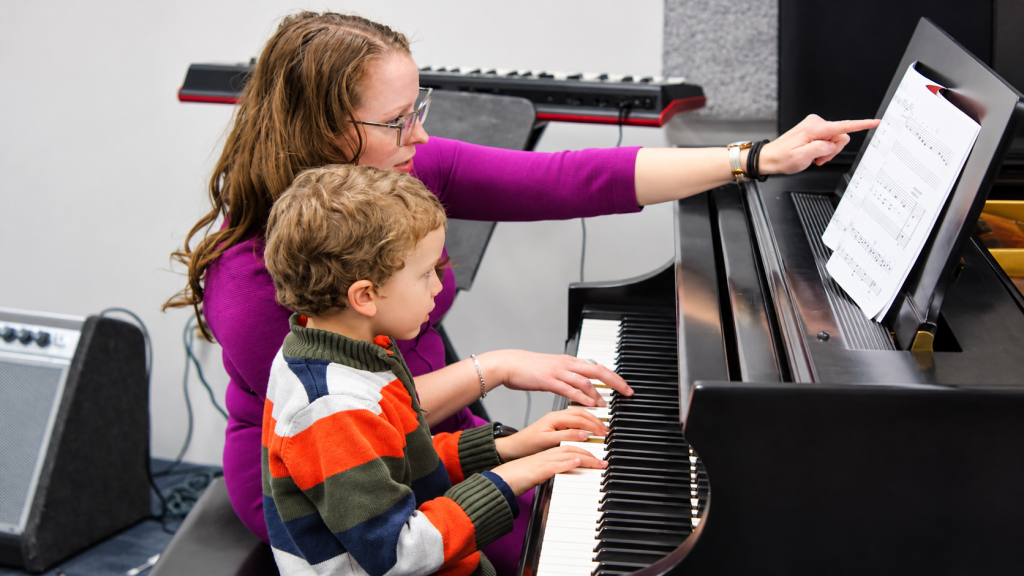
At Chambers, Piano Keys is designed so students learn in a small-group setting while still progressing through individualized material.
Students work on skills including music reading, rhythm, technique, ear training, theory, and independent practice.
The important word there is independent.
One of the goals of strong music education is for students to gradually need less help.
At first, a teacher may need to point out notes, identify mistakes, explain rhythms, and tell the student exactly what to practice.
Over time, we want the child to begin doing more of that work themselves.
They recognize the pattern.
They hear the mistake.
They decide to slow something down.
They know which section needs another repetition.
That shift from dependence to independence is an important part of becoming a musician.
You can learn more about the Chambers approach to music education and student progression through our structured musical pathway. Chambers currently describes that pathway as moving students from early musical experiences into increasingly independent and expressive musicianship.
Won't My Child Learn Faster in Private Lessons?
Maybe.
But the better question is:
Faster at what?
If the goal is to teach one particular song as quickly as possible, individual instruction may sometimes make that easier.
But learning music is much bigger than learning songs.
Children are also developing:
- rhythm
- music reading
- listening
- coordination
- technique
- ear training
- musical memory
- creativity
- independence
- ensemble awareness
- performance skills
- practice habits
- musical expression
A child can learn several songs and still depend heavily on a teacher to tell them what comes next.
Another student may move through repertoire more gradually while becoming significantly better at reading, listening, practicing independently, and solving musical problems.
The second kind of progress may be less obvious from the outside, but it can create a much stronger foundation for long-term musical growth.
The goal is not simply to move through music quickly. The goal is to build skills that last.
How Does Age Affect the Right Music Learning Environment?
Age is not the only factor in placement, but it matters.
The learning environment that works well for a 12-year-old may not be the best environment for a 4-year-old.
At Chambers, our programs are designed to evolve as children develop.
For our youngest musicians, early music experiences focus on singing, movement, listening, rhythm, and musical interaction.
Around ages 4–6, programs such as Jam Band allow children to begin participating in a more structured musical environment while still learning through movement, repetition, instruments, and ensemble experiences.
As students become ready for greater musical independence, they can begin developing more formal reading, technique, rhythm, ear training, theory, and practice skills.
Older students and students with appropriate musical foundations may then move into increasingly specialized private instruction.
Chambers’ studio policies describe this progression as a structured pathway that includes early childhood music, Jam Band, Piano Keys, and later private study.
Can Children Benefit From Both Group and Private Music Lessons?
Absolutely.
In fact, strong musicians often experience both.
Private lessons allow students to receive detailed, personalized instruction.
Group classes help them listen, collaborate, respond, and learn around other musicians.
Ensembles ask them to maintain their own musical responsibilities while remaining aware of everyone else.
Performances give students an opportunity to use their skills outside the comfort of the lesson room.
Independent practice teaches them to solve problems without a teacher standing beside them.
Each learning environment develops something different.
Even after students begin private lessons, making music with other people continues to matter.
Chambers also offers ensemble experiences, where students can develop group-specific skills such as collaboration, musical communication, and band dynamics while preparing to perform together.
How Do I Know Whether My Child Needs Group or Private Lessons?
Instead of starting with the assumption that one format is better, consider what your child needs right now.
If your child is very young, completely new to music, enjoys learning alongside peers, or is still developing foundational rhythm, listening, coordination, and attention skills, a developmentally appropriate group program may be an excellent starting point.
If your child is older, has previous musical experience, can work independently, and is ready to concentrate deeply on a specific instrument or voice, private instruction may make more sense.
Some students fall somewhere between those categories.
That is why good placement matters.
A music program should not simply ask, “Which instrument does your child want?”
It should also consider:
How old are they?
What musical experiences have they already had?
How independently can they work?
What skills are they ready to develop?
What environment will prepare them for the next stage?
What Should Columbus Parents Look for When Comparing Music Lessons?
Families searching for music lessons in Columbus, Bexley, Worthington, and Central Ohio have many options.
Rather than comparing programs only by price, lesson length, or whether they are private or group, ask what the program is actually designed to accomplish.
A few useful questions include:
What will my child be learning at this age?
Why is this teaching format appropriate for them?
How is individual progress monitored?
What skills should they develop before moving to the next level?
What comes after this program?
Those answers tell you much more than the number of students in the room.
The right environment should make sense not only for the lesson your child is taking today, but also for the musician they are becoming.
The BEST Music Lesson Is the One That Fits the Child
So, are group or private music lessons better for kids?
Neither one wins universally.
Group music lessons can provide young and beginning musicians with valuable opportunities to develop rhythm, listening, confidence, independence, and ensemble skills. Private lessons provide individualized instruction as students become ready for specialized technical and artistic development.
For many children, both will eventually become important parts of their musical education.
At Chambers Music Studio, we think about that development as a longer journey:
Music Time → Jam Band → Piano Keys → Private Lessons → Ensembles, Performances & Advanced Musical Experiences
Not every child will move through music in exactly the same way or at exactly the same speed.
What matters is giving them the skills they need for the stage they are in—and preparing them for the stage that comes next.
Because the goal is not simply to put your child into a music lesson.
It is to help them grow into a musician.
FAQ
Begin by taking our lesson assessment. We will learn more about your goals, interests, learning style, schedule, and previous musical experience. From there, our team will help match you with the right program, teacher, location, and lesson time.
Music lesson pricing depends on several factors, including the student’s age, experience level, instrument, lesson format, and selected plan. Complete our lesson assessment so we can learn more about your needs and recommend the best option for you or your student.
Lessons and classes at Chambers Music Studio are typically 45 or 60 minutes, depending on the student’s program, age, and learning needs.
VIP and VIP Plus are designed for families who are serious about music education and want additional flexibility and benefits. Depending on the selected plan, benefits may include unlimited scheduling and rescheduling, preferred pricing on studio expenses, access to local music events, exclusive gifts, and priority access to select opportunities.