Whether you are a parent, a music teacher, or a studio owner, you have likely witnessed the “early music lesson struggle”. As we head into spring and begin looking toward summer activities, it is the perfect time to rethink how we introduce our youngest learners to the world of music.
In this episode, we dive into the Jam Band philosophy—a specialized approach for children ages 4–6 that moves away from the frustrations of traditional private lessons and toward a developmental “sweet spot”.
The "Developmental Mismatch of Traditional Lessons
Many parents feel that if their child shows high interest in an instrument, they should start private lessons immediately. However, traditional one-on-one instruction often creates a “developmental mismatch” for children ages 4–6.
Attention Constraints: Expecting a young child to sit still for 30 minutes is often unrealistic, leading to lessons spent more on behavior management than musical momentum.
Physical Barriers: Instruments like the guitar require fine motor control and finger strength that young children haven’t developed yet. Similarly, brass and woodwinds require breath control and embouchure that are not yet developmentally appropriate.
The Ensemble Gap: Students who learn only in private settings often struggle later to play with others, as they are used to only hearing themselves and may stop the moment they make a mistake.
“In an ensemble, stopping isn’t an option—learning to recover is the skill.”
What is Jam Band?
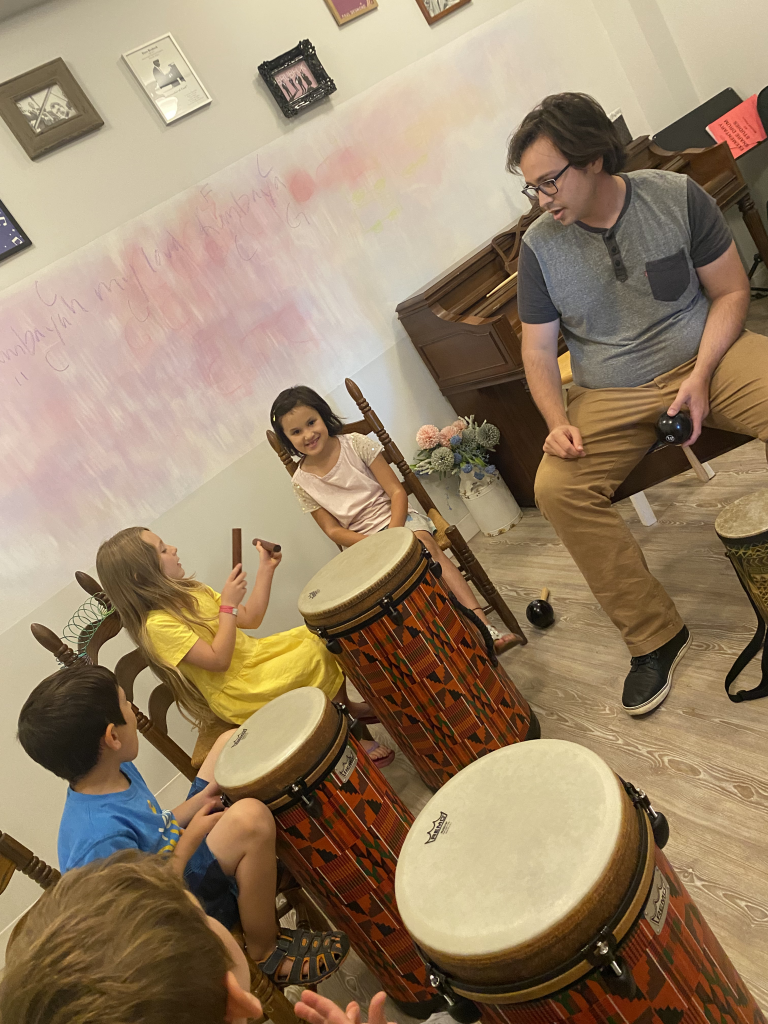
Jam Band is a small-group, ensemble-based music class specifically designed for the 4-to-6-year-old brain. Rather than narrowing in on a single instrument immediately, students sing, move, and play a variety of instruments to learn how music works as a whole.
Movement-Based Learning: Rhythm lives in the body first. Movement supports focus, memory, and engagement.
Peer Modeling: Children learn faster by watching their peers, which builds natural confidence and motivation.
Pressure-Free Exploration: Students gain exposure to various instruments before specializing, which prevents early burnout and leads to better long-term instrument choices.
Strategic Instrument Preparation
Jam Band doesn’t just “play around”—it builds a bridge to future musical success through developmentally appropriate tools:
Future Goal
Jam Band "Bridge"
Why it Works
Guitar
Ukulele
Smaller size and softer strings lead to immediate success and chord readiness.
Drum Set
Tubanos & Djembes
Teaches proper hand technique and steady beat without the coordination overload of a full kit.
Voice
Group Singing
Uses echo songs and games to teach pitch matching without the pressure of one-on-one repetition
Brass/Woodwinds
Theory & Ear Training
Builds reading readiness and ensemble awareness so students start band ahead of the curve.
The Pedagogy: From Known to Unknown
The Jam Band method follows a simple but powerful progression. We start with what the child already possesses—their voice and their body—and use simple patterns to build a foundation. Only then do we move toward complex instruments, musical symbols, and reading and writing.
“We don’t rush children into complexity—we prepare them for it.”
By focusing on this foundation, students develop essential skills like steady beat, musical memory, and emotional regulation that transfer directly to classroom success.
Musical Tip: Practice "Staying in the Music"
The episode concludes with a vital tip for parents: model resilience. Encourage your child to keep going even after they make a mistake. By celebrating effort and “staying in the music,” you help them build the confidence needed for a lifelong musical journey.